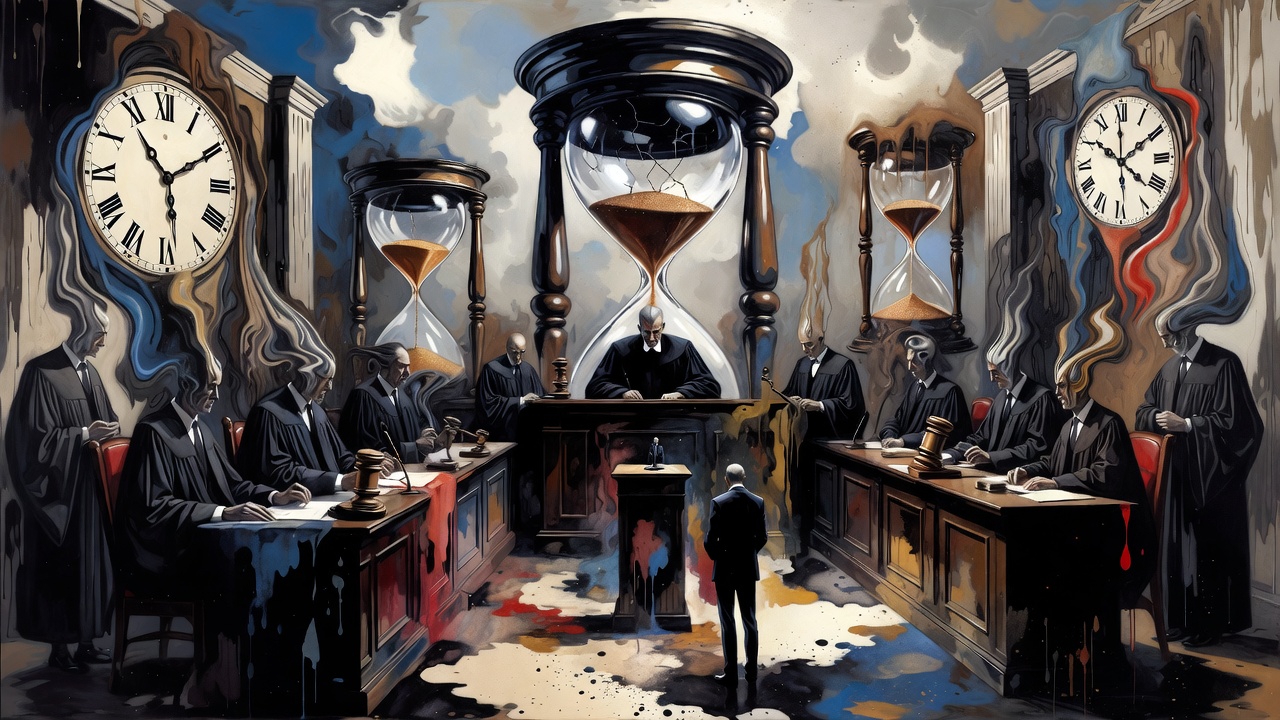

The Art of Showing Up Late (Opposition to Default Judgments)
In Polish civil procedure, absence has consequences—but not always permanent ones. A defendant who fails to respond to a lawsuit may find himself on the receiving end of a default judgment, issued without his participation. Yet the law provides a remedy: within two weeks of receiving such a judgment, the defendant can file an opposition, a legal instrument that, despite its name, functions less like an appeal than like a second chance.
When Silence Becomes Consent
A court may issue a default judgment at a closed hearing when the defendant fails to submit a response to the lawsuit within the designated time frame. In such circumstances, the plaintiff’s factual allegations—those contained in the complaint or in procedural documents served on the defendant before the hearing—are presumed true, unless they raise justified doubts or appear designed to circumvent the law.
This presumption doesn’t relieve the plaintiff of the obligation to present facts necessary for assessing the merits of the claim—the foundation upon which any judgment must rest. The court remains obligated to evaluate the claim even when accepting the plaintiff’s allegations as true. (A February, 2020, ruling from the Regional Court in Suwałki established this principle.)
The Civil Procedure Code doesn’t preclude issuing a default judgment after conducting evidentiary proceedings. This means that a trial court—faced with a defendant’s complete passivity—isn’t absolutely obligated to issue a default judgment based solely on the plaintiff’s allegations but may conduct evidentiary proceedings, particularly from evidence cited by the plaintiff. (The Gdańsk Court of Appeals confirmed this in January, 2022.)
One further detail: when a default judgment grants the plaintiff’s claim, the court automatically endows it with immediate enforceability—a procedural gift that makes the judgment executable without delay.
Two Roads Diverging
A defendant against whom a default judgment has been entered may file an opposition. The plaintiff, meanwhile, may appeal the default judgment. The fundamental difference between opposition and appeal is that opposition doesn’t send the case to an appellate court for review and resolution. In certain circumstances, these distinct remedies may intersect. When a default judgment partially grants the plaintiff’s claim while partially dismissing it, the plaintiff has the right to appeal the dismissal, and the defendant may file an opposition to the granting portion.
These remedies must be carefully distinguished. When a lawyer challenges a default judgment through an appeal rather than—as the statute requires—through opposition, the error cannot be dismissed as an obvious oversight devoid of negative procedural consequences. Documents submitted by professional representatives cannot be given meanings different from those they unmistakably intended. (The Supreme Court held this in November, 2006.)
The Phantom Judgment
Because statutory law makes proper “service” of the judgment on the defendant a condition for challenging a default judgment through opposition (Article 344, Section 1, of the Code of Civil Procedure), the absence of effective service means the judgment never becomes final.
In one case considered by the Supreme Court, the defendant learned of the default judgment’s contents even though the judgment was never formally served on him. In response, he filed a motion to reopen the proceedings concluded by that judgment, but the motion was ultimately rejected. Under these circumstances, the Supreme Court held that the final rejection of the motion to reopen didn’t cure the court’s failure to fulfill its statutory obligation (under Article 343) to properly serve the defendant with the default judgment and inform him of his right to file an opposition. (The Court ruled accordingly in October, 2007.)
This stems from a fundamental principle: a court’s erroneous determination that a default judgment was properly served on the defendant doesn’t cause that judgment to become final. (The Supreme Court articulated this in April, 1988.)
For the same reasons, courts have held that general information in a bailiff’s notice about initiating enforcement proceedings—from which one might indirectly infer that a judgment was entered and discern its contents—cannot satisfy the statutory requirement of serving the defendant with a copy of the default judgment under Article 343. Default proceedings constitute an exception to the basic procedural requirement of hearing the other side. One cannot, therefore, interpret service provisions in a way that would further restrict the defendant’s ability to defend against a default judgment. (The Supreme Court ruled thus in December, 1998.)
The Contents of Opposition
In a document containing an opposition, the defendant should present objections that, on pain of losing them, must be raised before engaging with the merits of the case, as well as factual allegations and evidence.
Article 344, Section 2, of the Code of Civil Procedure specifies what an opposition to a default judgment must contain. According to this provision, the document must set forth the defendant’s objections to the plaintiff’s claim and the facts and evidence supporting them. A document lacking these elements suffers from a formal defect, and the person filing the opposition is summoned to cure it under Article 130, Section 1. (The Supreme Court clarified this in March, 2000.)
The court rejects an opposition that is inadmissible, untimely, unpaid, or afflicted with defects that remain uncured despite notice. Under Article 344, Section 3, the court issues a separate order regarding the opposition’s fate only when it finds grounds for rejection. It doesn’t issue an order refusing to reject the opposition; rather, an effectively filed opposition is presumed to produce the effects described below. (The Wrocław Court of Appeals explained this in May, 2013.)
What Opposition Accomplishes
When an opposition is filed, the presiding judge orders it served on the plaintiff and sets the case in motion, undertaking—as necessary—the actions prescribed in provisions concerning case organization.
The default judgment doesn’t lose force simply because an opposition is filed. Filing an opposition merely causes the presiding judge to schedule a hearing and serve a copy of the opposition on the plaintiff—provided the opposition complies with applicable provisions and is accepted. A default judgment endowed with immediate enforceability may be executed unless the court, at the defendant’s request, suspends that enforceability. The default judgment loses force only when it’s vacated by a final judgment. (The Supreme Court held this in April, 1969.)
However, upon the defendant’s motion, the court will suspend the immediate enforceability granted to a default judgment if the judgment was issued in violation of provisions governing when it may be entered, or if the defendant makes plausible that his failure to appear was not his fault and the circumstances presented in the opposition raise doubts about the default judgment’s validity. In suspending enforceability, the court may order protective measures.
Moreover, the court may lift the immediate enforceability granted to a default judgment if the defendant demonstrates that a copy of the complaint was served under the procedure prescribed in Article 139, Section 1 (substitute forms of service) at an address other than the defendant’s actual place of residence on the date of service.
April 12, 2024

Robert Nogacki – licensed legal counsel (radca prawny, WA-9026), Founder of Kancelaria Prawna Skarbiec.
There are lawyers who practice law. And there are those who deal with problems for which the law has no ready answer. For over twenty years, Kancelaria Skarbiec has worked at the intersection of tax law, corporate structures, and the deeply human reluctance to give the state more than the state is owed. We advise entrepreneurs from over a dozen countries – from those on the Forbes list to those whose bank account was just seized by the tax authority and who do not know what to do tomorrow morning.
One of the most frequently cited experts on tax law in Polish media – he writes for Rzeczpospolita, Dziennik Gazeta Prawna, and Parkiet not because it looks good on a résumé, but because certain things cannot be explained in a court filing and someone needs to say them out loud. Author of AI Decoding Satoshi Nakamoto: Artificial Intelligence on the Trail of Bitcoin’s Creator. Co-author of the award-winning book Bezpieczeństwo współczesnej firmy (Security of a Modern Company).
Kancelaria Skarbiec holds top positions in the tax law firm rankings of Dziennik Gazeta Prawna. Four-time winner of the European Medal, recipient of the title International Tax Planning Law Firm of the Year in Poland.
He specializes in tax disputes with fiscal authorities, international tax planning, crypto-asset regulation, and asset protection. Since 2006, he has led the WGI case – one of the longest-running criminal proceedings in the history of the Polish financial market – because there are things you do not leave half-done, even if they take two decades. He believes the law is too serious to be treated only seriously – and that the best legal advice is the kind that ensures the client never has to stand before a court.